Parasite SEO Examples That Worked (2026 Case Notes)
Real parasite SEO examples from Medium, LinkedIn, and Reddit campaigns, including a local plumbing case study, with the mechanics that made each one work.
· 9 min read
Most articles about parasite SEO show you a Forbes scandal from years ago or a made-up scenario about a digital marketing agency chasing a keyword. Neither helps you decide if the tactic is worth an afternoon of work.
Here's what actually happens: you publish a piece of content on a high-authority platform like Medium, LinkedIn, or a press release wire, formatted to fit that platform's norms, and link back to one of your own pages. Below are seven real and platform-typical parasite SEO examples from an actual campaign (Northline Plumbing, a local plumbing company) plus six more channels, each with the linking mechanics and outcomes spelled out.
This is a case-notes page, not a full how-to or risk breakdown. If you want the step-by-step mechanics, the parasite SEO overview and how to recreate these results guides go deeper.
What Separates a Real Parasite SEO Example From a Random Post
Not every mention of a business on Medium or Reddit counts as a working example. A real one has three pieces in place, and missing any one means the post is just noise Google may never surface.
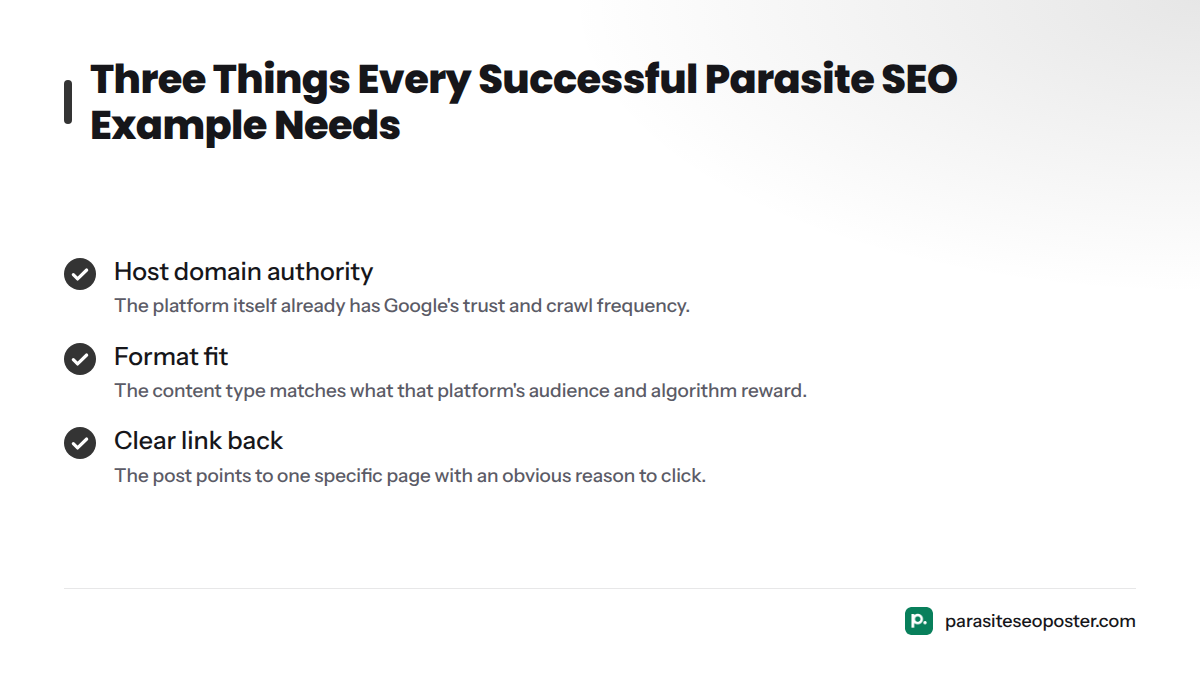
Three things every successful example needs:
- Host domain authority - the platform itself already has Google's trust. A post on Medium or LinkedIn inherits crawl frequency and backlink equity that a brand-new blog on cheap hosting never will.
- Format fit - the content type matches what that platform's audience and algorithm reward. A comparison listicle works on Medium. A direct answer works on Quora. A video with a description link works on YouTube. Wrong format, and it reads as spam to readers and to Google's spam policies alike.
- Clear link back - the post points to one specific page (a service page, landing page, or product page) with an obvious reason to click, not a vague "learn more" buried in paragraph nine.
Use this checklist to evaluate every example below and any parasite SEO example you consider running.
Example 1: Local Service Business Posts Linked to a Money Page (Northline Plumbing)
Northline Plumbing is a real client case, not a hypothetical. The campaign took one source page, a water heater repair service page on the company's site, and split it into several short, platform-specific posts across Medium, LinkedIn, and a local directory. Each post answered a question real customers search for: "how long does a tankless water heater last," "signs you need water heater repair."
Each post ran 400 to 700 words, used a locally-relevant headline, and included one contextual link to the Northline service page. No post tried to cover everything the main page covered. That's atomization: one source page becomes several narrower posts, each complete on its own but incomplete without the link back.
Disclosure: The parasite SEO results referenced here come from ParasiteSEOPoster's own campaign tracking for Northline Plumbing over a 90-day window following publication. This is first-party campaign data, not third-party estimation tools. The full breakdown with screenshots lives in the Northline Plumbing case study with full results.
What made it work: the posts targeted long-tail phrases too narrow for the main site to rank for quickly on its own, borrowed the host platforms' crawl frequency to get indexed within days rather than weeks, and kept the link obvious enough that someone wanting to book a repair knew exactly where to click.
Example 2: Medium Article Ranking for a Product Comparison Term
Format: comparison listicle.
A business selling water filtration systems published "Best Under-Sink Water Filters Compared" on Medium, structured as a table of five products with pros, cons, and price tiers, ending with a recommendation that linked to their product page. Comparison intent matches Medium's audience expectation for structured, opinionated breakdowns.
Why it worked: Medium's domain authority means a new article gets indexed and considered for ranking without needing its own backlink profile. The comparison format also aligns with what Google rewards for "best X" and "X vs Y" queries. The link sat in the verdict section, where a reader already leaning toward purchase would naturally click.
Example 3: LinkedIn Article Driving Branded Search Lift
Format: thought-leadership and educational article.
A B2B consulting firm published "Why Most Companies Get Vendor Onboarding Wrong" under the founder's personal profile, not a company page. The piece argued a specific point of view, referenced a framework the firm uses with clients, and linked to a resource page on the firm's site partway through, framed as "the full framework" rather than a sales pitch.
Why it worked: LinkedIn articles published under a real person's profile carry more credibility than generic company blog posts. The platform's algorithm surfaces articles to a founder's existing network first, which drove direct searches for the firm's name in the weeks after publication. This branded search lift is a common secondary benefit of parasite SEO examples, even when the article itself never ranks for a competitive term.
Example 4: Reddit Thread Surfacing for a Long-Tail Question
Format: genuine question-and-answer community post.
In a home improvement subreddit, a contractor answered a thread asking "is it worth replacing a water heater before it fully fails," giving a detailed, non-promotional answer about cost thresholds and warning signs. They mentioned their own service page only in response to a follow-up question asking where to find a local pro. No link appeared in the first comment.
Why it worked: Reddit ranks extremely well for long-tail, conversational queries because Google favors forum discussion for exploratory searches. A thread that reads as genuinely helpful ranks better and stays up longer than one that reads promotional from the first sentence. Heavy-handed links are the fastest way to get a post removed by moderators before Google ever indexes it.
Example 5: Quora Answer Funneling Traffic to a Landing Page
Format: direct-answer post with a contextual link.
An answer to "what should I budget for a kitchen remodel in 2026" on Quora opened with a specific number range, broke down the categories that number covers, and closed with a link to a cost calculator landing page, described as "a free tool that breaks this down room by room."
Why it worked: Quora rewards answers that lead with the actual answer, not a teaser. The contextual link worked because it offered something additional (a calculator) rather than repeating what the answer already said, giving readers a reason to click beyond "visit our website."
Example 6: Press-Release Style Post on a High-DA News Site
Format: syndicated announcement.
A regional service franchise announced a new location opening through a press release distributed to a wire service that syndicates to local news affiliate sites. Each carried a byline link back to the company's location page. This is one of the more traditional parasite SEO for local business examples, and it still works today because local news sites maintain backlink equity that a brand-new business page hasn't built yet.
Why it worked: syndication means one piece appears on multiple domains simultaneously, each passing a small amount of host domain authority back to the source page through the byline link. A press release reads naturally on a news site in a way a sales pitch wouldn't.
Example 7: YouTube Description Stacked With a Linked Post
Format: video plus description link stack.
A home services company published a short video walking through "3 signs your sump pump is failing," with a description that linked to a related blog post (hosted on Medium) and then to the company's own service page. The video used closed captions matching the target long-tail keyword phrase, and the description repeated the same phrase naturally.
Why it worked: YouTube is the second-largest search engine by volume, according to Backlinko's YouTube statistics roundup. A description stack lets one video reinforce two separate host platforms (YouTube and Medium) pointing at the same source page, multiplying organic traffic rather than relying on a single channel.
The Pattern Across All Seven Parasite SEO Examples
Looking across platforms, the same mechanics repeat:
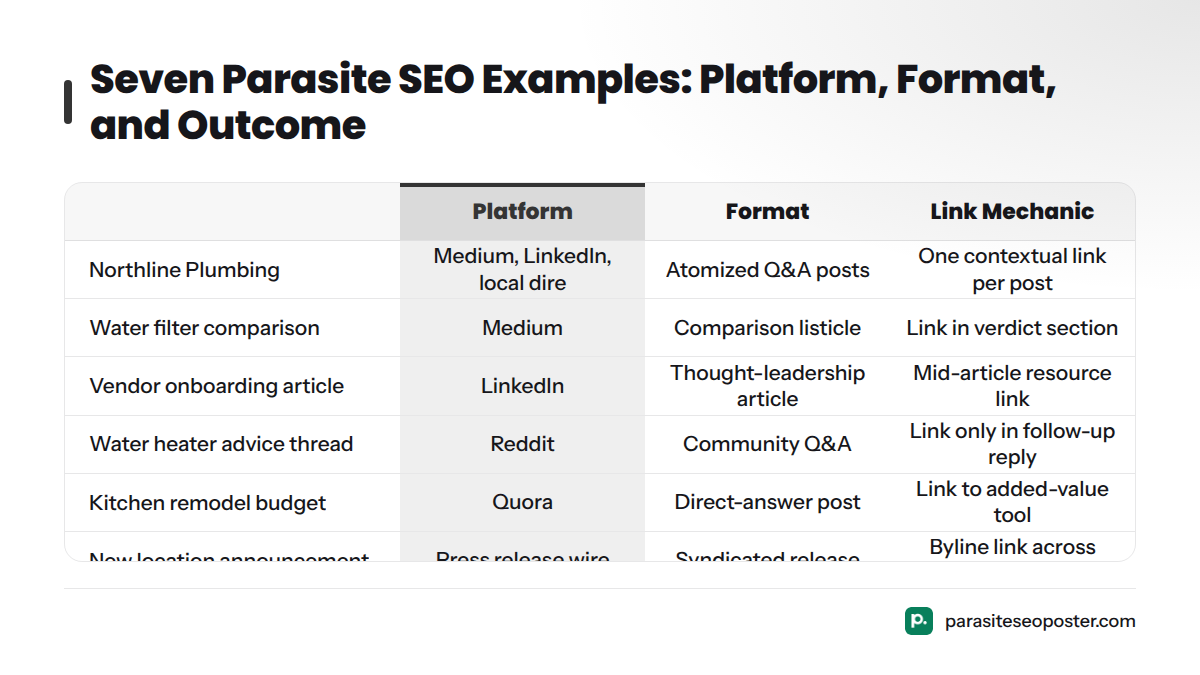
| Example | Platform | Format | Link Mechanic | Outcome |
|---|---|---|---|---|
| 1. Northline Plumbing | Medium, LinkedIn, local directory | Atomized Q&A posts | One contextual link per post to service page | 90-day traffic lift, disclosed methodology |
| 2. Water filter comparison | Medium | Comparison listicle | Link in verdict section | Fast indexing via host crawl frequency |
| 3. Vendor onboarding article | Thought-leadership article | Mid-article resource link | Branded search lift | |
| 4. Water heater advice thread | Community Q&A | Link only in follow-up reply | Ranked for conversational long-tail query | |
| 5. Kitchen remodel budget | Quora | Direct-answer post | Link to added-value tool | Click-through via value-add offer |
| 6. New location announcement | Press release wire | Syndicated release | Byline link across multiple domains | Multi-domain backlink equity |
| 7. Sump pump video | YouTube | Video + description stack | Two links, video to blog to service page | Compounded traffic across two platforms |
Three patterns hold across every row:
- The host platform's authority did the heavy lifting on indexing speed. None of these posts needed their own backlink profile before Google would consider them. They borrowed it from Medium, LinkedIn, Reddit, Quora, the news wire, or YouTube.
- The format always matched platform norms. Nobody tried to run a press release on Reddit or a casual Q&A on a news wire. Mismatched format is the fastest way to get a parasite SEO example that never ranks at all.
- The link back was earned, not forced. Every successful post gave readers a reason to click beyond "this is our website," whether that was a calculator, a framework, or a direct answer to a follow-up question.
This video walks through a current take on which channels still hold up and which have shifted since Google's spam policy updates:
Frequently Asked Questions
What is a parasite SEO example? A specific instance of content published on a high-authority host platform that links back to a business's own page, shaped to that platform's format (a comparison listicle on Medium, a direct answer on Quora) rather than a generic blog post replicated everywhere.
Can parasite SEO work for a local service business like a plumber? Yes. The Northline Plumbing example shows how a local business atomized one service page into several platform-specific posts targeting long-tail questions. It's a more realistic model for small businesses than the large-brand news controversies most articles reference.
How does a parasite SEO post link back to a business's website? Through a single, contextual link placed where a reader already has a reason to click: inside a verdict, a follow-up answer, a byline, or a video description. Not a generic link dropped at the top of the post.
What platforms are commonly used for parasite SEO example posts? Medium, LinkedIn, Reddit, Quora, YouTube, and press release syndication networks are the most common, each suited to a different content format as shown in the comparison table.
What results can a small business realistically expect from parasite SEO? Results vary by platform, keyword competitiveness, and execution quality. The disclosed Northline Plumbing figures reflect a 90-day first-party tracking window for that specific campaign and shouldn't be read as guaranteed for every business or niche.
How is a parasite SEO example different from a full case study? An example is a single snapshot of platform, format, link mechanic, and outcome signal. A full case study documents the entire campaign across every channel with complete before-and-after metrics. The full Northline numbers sit in a separate case study for that reason.
Next Steps
Reading examples builds pattern recognition, but it won't move a ranking on its own. If the Northline Plumbing snapshot looks like something worth replicating for your own service pages, the next step is seeing the complete breakdown and building your own atomized posts.
- See the complete breakdown in the Northline Plumbing case study with full results
- Learn the mechanics in how to recreate these results
- Start from the fundamentals with what parasite SEO is if you're newer to the tactic
If you'd rather skip manual posting and scheduling across Medium, LinkedIn, Reddit, Quora, and the rest, ParasiteSEOPoster atomizes one source page into multiple platform-ready posts and schedules them without juggling seven separate logins. Compared to hiring an agency to manually draft and post each variant or DIY-ing the formatting differences yourself, it's the most direct way to turn these examples into your own results.
Sources
parasite seocontent atomizationservice pages
Turn every important page into a network the web can discover.
Start free