SocialBee Alternatives for Small Business in 2026
Small business owners rarely switch scheduling tools on impulse. They switch because friction builds in the workflow: costs that climb with every new social account, content categories that demand an afternoon of setup before a single post goes live, or the creeping sense that they're spending more time curating than creating.
If that describes your situation, here's what works: the strongest SocialBee alternatives for small business in 2026 are ParasiteSEOPoster, Buffer, Publer, Metricool, Later, Hootsuite, and Loomly - each suited to a different owner and workflow. Let's break down why teams leave, what each tool does well, and how to pick the right one without burning a week on trials.
Why Small Businesses Leave SocialBee
SocialBee built its reputation on a specific structure: sort posts into labeled categories, set a posting ratio between them, and let the tool cycle through on a schedule. It works. But working and fitting a solo owner's Tuesday afternoon aren't always the same thing.
How content category queues work
A content category queue is SocialBee's core organizing principle. Instead of one flat calendar, you create labeled buckets - say, "Promotions," "Tips," "Customer Stories," "Curated Industry News" - and assign each a posting frequency. The tool rotates through them automatically, which genuinely helps teams with a steady content pipeline who want a balanced mix. The catch: someone still has to write, tag, and sort that content before the system can publish it. For a solo owner without a content team, that sorting step often becomes the real bottleneck, not the scheduling itself.
What is a content category queue? A labeled content bucket (like "tips" or "promotions") that a scheduling tool rotates through on a set ratio or frequency, keeping your posting mix balanced without manual daily choices. It organizes existing content. It does not create new content.
The three reasons teams switch
Across review sites, forums, and conversations with small-business owners, the same three complaints surface repeatedly:
-
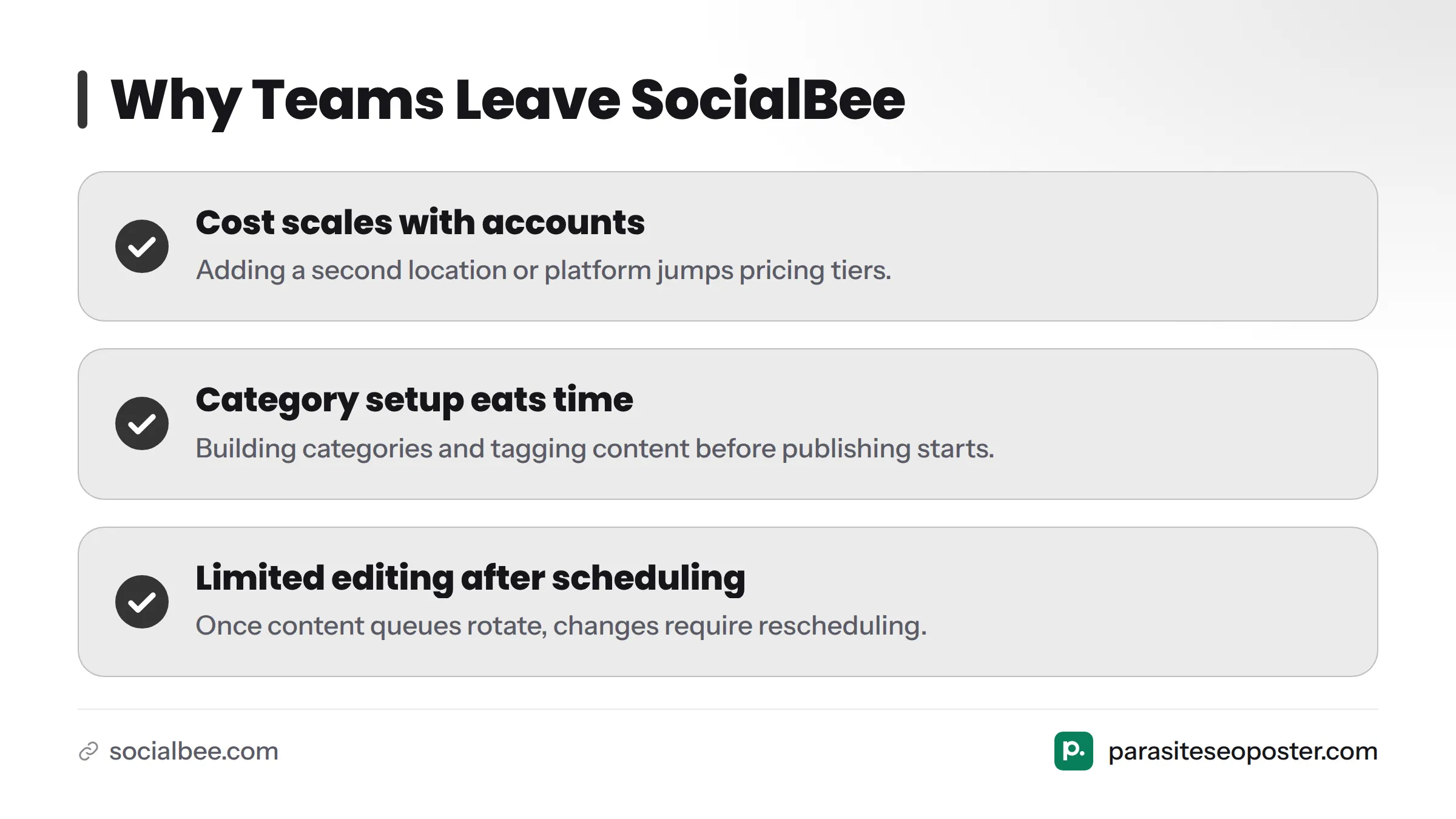
Cost scales with accounts. SocialBee's pricing is tied to the number of connected social accounts and posting volume. A business adding a second location, new platform, or second brand often jumps a pricing tier. Check SocialBee's live pricing page for current plan limits before budgeting.
-
Category setup eats time. Building categories, tagging content correctly, and setting rotation ratios is a one-time task, but many solo owners don't have an hour to spend on it.
-
Curation exhaustion. SocialBee is built to organize and recycle content you already own. If you're short on content or want fresh posts generated automatically, the category-queue model doesn't address your actual problem - it just organizes an insufficient supply.
That last point is why this list differs from the typical "10 schedulers ranked" roundup. A beautiful curator still leaves you responsible for creating the content in the first place.
How We Compared These Alternatives
Every tool below used the same evaluation criteria, not review-site star counts alone.
What we measured
- Workflow model - Does the tool curate existing content (like SocialBee), generate new content, or both?
- Pricing - What's actually included in the entry-level paid tier, and is there a usable free plan?
- Channels supported - Which networks can you publish to natively?
- Setup speed - Can a solo owner publish within an hour, or does it require a content audit first?
We checked each vendor's pricing and feature pages directly rather than relying on secondhand reviews, and we note the verification date so you know the information is current as of this writing in November 2026. Pricing and limits change frequently in this space, so always confirm on the vendor's own page before committing.
Disclosure: ParasiteSEOPoster, listed first below, is our own product, built by the team at ParasiteSEOPoster. We're naming that upfront so you can weigh our framing accordingly. We still describe its limits honestly, and we've included six other tools we did not build.
1. ParasiteSEOPoster - Best for Turning Website Pages Into Posts
Most schedulers, SocialBee included, assume you already have content to schedule. ParasiteSEOPoster starts elsewhere: your website already has the content. Service pages, blog posts, case studies, and product pages sit full of material that's never reached social media, because converting a page into a post requires tedious manual work.
The source-page approach
A source-page approach means the tool reads an existing page on your website and generates social post drafts directly from that page's substance, rather than asking you to write from scratch or sort into categories. You point it at a URL, it pulls the page's core material, and it drafts platform-appropriate posts you can review, edit, and schedule. Before publishing, it runs a competitiveness check - a quick comparison of your draft against what's already ranking or circulating on that topic - so you're not posting something generic that blends into the noise. For a small business with years of website content but almost no social media presence, this flips the usual problem: instead of "what do I post today," it becomes "which of my 40 existing pages should I turn into posts first."
Try it: turn one page into posts as a test. Pick your best-performing landing page or most detailed blog post. Run it through ParasiteSEOPoster and see how many distinct social posts come out. Most small business owners are surprised it's more than two or three. That's the fastest way to judge whether a source-page workflow fits your business better than a category-queue one.
Strengths, limits, and pricing
Strengths:
- Builds posts from content you already own, so content creation speed is dramatically faster than writing from a blank page
- Competitiveness check adds quality control most schedulers skip entirely
- No category setup or tagging required before you publish
- Good fit for service businesses, consultants, and ecommerce stores with existing website content but thin social media history
Limits:
- Not built for pure content curation workflows (if your main need is recycling industry news or other people's content, a category-based tool fits better)
- Best value emerges once you have a reasonable amount of existing website content to draw from
For current plans and what's included at each tier, see ParasiteSEOPoster's pricing page.
2. Buffer - Best for Simple, Budget-Friendly Scheduling
Buffer built its name on being the scheduler that doesn't make you think. No content categories to configure, no rotation ratios to tune - just a clean calendar and a straightforward queue per channel.
Strengths: Clean interface, genuinely easy for a first-time scheduler user, and a free plan that covers a small number of channels, making it one of the more realistic free SocialBee alternatives for a solo owner testing a different approach.
Limits: Buffer's content creation tools are lighter than category-based or AI-generation tools, so you're still responsible for writing most of what you post. Check Buffer's current pricing for channel limits on each tier, since those numbers shift periodically.
Best for: Solo business owners and freelancers who want simplicity over structure and don't need a complex content calendar.
3. Publer - Best Direct Match for SocialBee's Workflow
Publer is probably the closest like-for-like swap for someone who liked SocialBee's structure but wants a different price point. It supports bulk scheduling, content recycling for evergreen posts, and a workspace model that scales as you add accounts.
Strengths: A genuinely usable free plan, support for evergreen content recycling similar to SocialBee's category rotation, and broad platform coverage.
Limits: Because the workflow mirrors SocialBee's, you inherit some of the same setup overhead - you're still organizing and recycling content rather than generating it fresh.
Best for: Former SocialBee users who liked the category and recycling concept but want a cheaper tier for a small number of accounts. Confirm current limits on Publer's pricing page.
4. Metricool - Best for Owners Who Also Want Analytics in One Place
Metricool blends scheduling with fairly deep analytics and even ad performance tracking, which matters if you're a small business that also runs paid social or wants to see organic and paid results side by side without a second login.
Strengths: Strong reporting for the price, supports a wide range of channels, and its free tier is usable for a single brand testing things out.
Limits: The scheduling interface focuses on calendar-and-queue rather than content categories, so if you specifically wanted SocialBee's rotation logic, you won't find a direct match here.
Best for: Ecommerce stores and local service businesses that want posting and performance data in one dashboard. See Metricool's pricing for current plan details.
5. Later - Best for Visual-First Brands
Later started as an Instagram scheduler and still shows that heritage in its visual content calendar, drag-and-drop media library, and link-in-bio tools built into every plan.
Strengths: Strong for businesses that live on Instagram and Pinterest, intuitive visual calendar, and a link-in-bio feature that saves a separate subscription.
Limits: Less suited to text-heavy platforms like LinkedIn or X, and its content categories and automation are lighter than SocialBee's rotation system.
Best for: Retail, hospitality, and other visually driven small businesses. Current tiers are listed on Later's pricing page.
6. Hootsuite - Best for Multi-Channel Teams That Need Depth
Hootsuite is one of the oldest names in this category, and that shows in the breadth of channels, team permissions, and reporting it supports.
Strengths: Deep multi-channel publishing, solid team collaboration tools, and integrations with a wide range of other marketing software.
Limits: Pricing climbs quickly once you add team seats or multiple accounts, and the learning curve is steeper than Buffer or ParasiteSEOPoster for a first-time user. One comparison found that SocialBee and Hootsuite can land at a similar monthly price point while delivering very different feature depth, so it's worth checking exactly what each tier includes before assuming either is the cheaper option.
Best for: Growing small businesses that have outgrown a single-user tool and need a handful of team members publishing across many channels. Confirm current limits on Hootsuite's pricing page.
7. Loomly - Best for Teams That Want Built-In Approval Workflows
Loomly leans into collaboration, with post ideas, approval flows, and feedback built directly into the calendar - useful for small teams that aren't a solo operation but also aren't a full marketing department.
Strengths: Built-in content ideas when you're short on inspiration, clear approval and commenting workflow, and solid channel coverage.
Limits: Less focused on AI content generation or source-page workflows, so you're still largely responsible for writing original posts.
Best for: Small teams of two to five people who need a lightweight review step before anything goes live. Pricing tiers are listed on Loomly's pricing page.
If none of these quite match your workflow, it's also worth checking the full social media scheduler comparison for a broader view, or looking specifically at AI-first options like Blaze if automated content generation is your main priority over scheduling mechanics.
Which SocialBee Alternative Fits Your Business?
Here's the shortlist side by side, including SocialBee itself for reference.
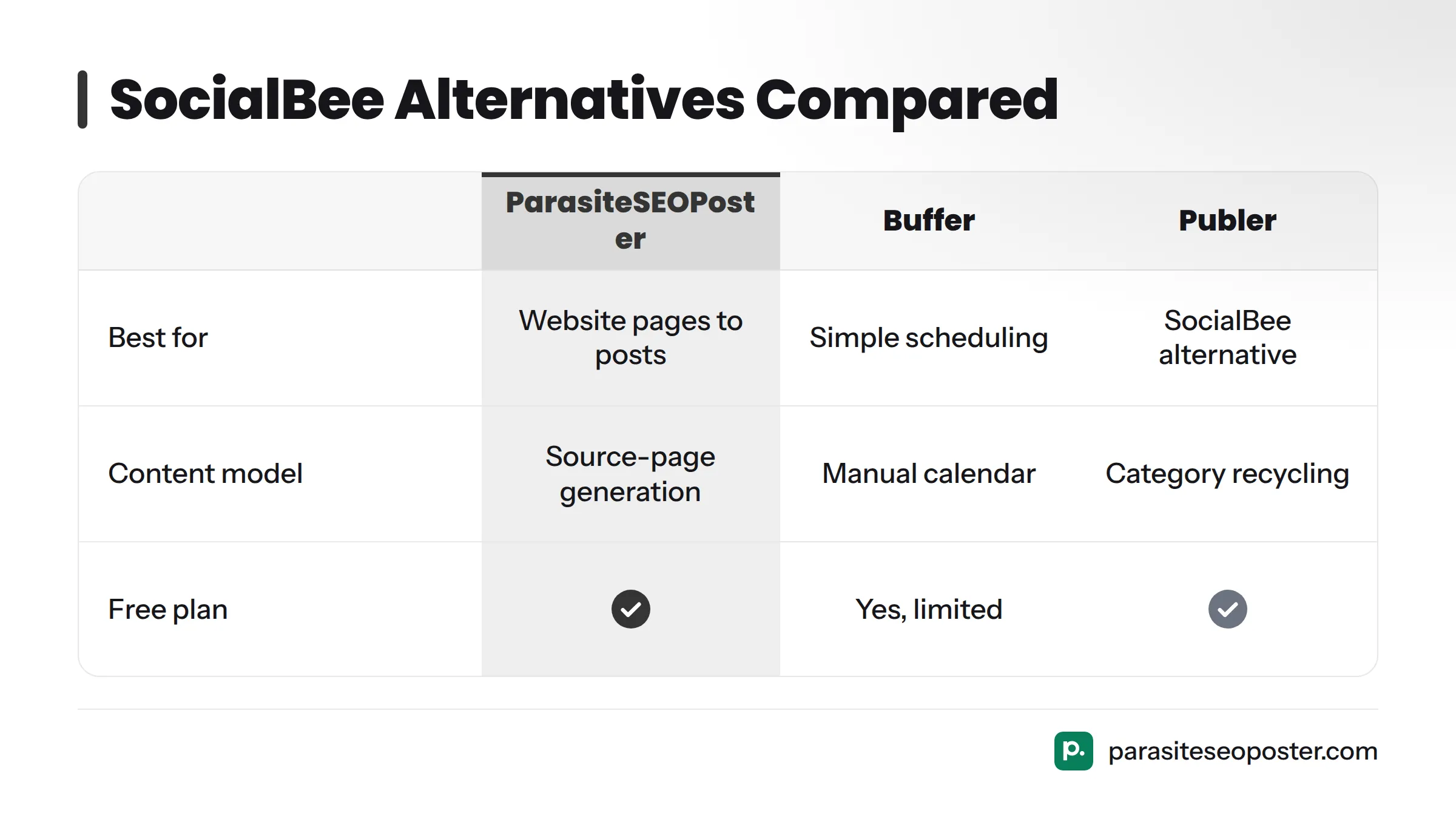
| Tool | Best For | Starting Price Pointer | Content Source Model | Free Plan? |
|---|---|---|---|---|
| ParasiteSEOPoster | Turning website pages into posts | See pricing page | Source-page generation | Yes |
| SocialBee | Category-based content recycling | See SocialBee pricing | Category queues | Trial only |
| Buffer | Simple, budget-friendly scheduling | See Buffer pricing | Manual calendar | Yes, limited channels |
| Publer | Closest like-for-like SocialBee swap | See Publer pricing | Category/recycling | Yes |
| Metricool | Scheduling plus analytics | See Metricool pricing | Manual calendar | Yes, single brand |
| Later | Visual-first brands | See Later pricing | Visual calendar | Yes, limited |
| Hootsuite | Multi-channel teams needing depth | See Hootsuite pricing | Manual calendar | Trial only |
| Loomly | Built-in approval workflows | See Loomly pricing | Manual calendar with idea prompts | Trial only |
A simple decision framework
- If you have existing website content but little social media presence, choose ParasiteSEOPoster and start with the source-page approach.
- If you want the lowest-effort, lowest-cost calendar, choose Buffer.
- If you liked SocialBee's category-queue logic but want a cheaper tier, choose Publer.
- If analytics and ad performance matter as much as scheduling, choose Metricool.
- If your business lives on Instagram or Pinterest, choose Later.
- If you've outgrown solo tools and need team permissions, choose Hootsuite.
- If a small team needs built-in approval steps before anything publishes, choose Loomly.
This short video walks through how SocialBee's pricing holds up against the alternatives, which is useful context if cost is your main driver for switching:
FAQ
What is a good alternative to SocialBee?
ParasiteSEOPoster, Buffer, and Publer are three of the strongest SocialBee alternatives for small business owners in 2026. ParasiteSEOPoster suits businesses with existing website content who want posts generated automatically, Buffer suits owners who want the simplest possible setup, and Publer suits anyone who liked SocialBee's category-queue structure but wants a lower price point.
Why do users look for SocialBee alternatives?
Most switchers cite three reasons: pricing that climbs as they add social accounts, the setup time required to build and tag content categories before posting even starts, and a preference for tools that generate fresh content rather than only organizing content they already have.
Do I need content categories to schedule well?
No. Content categories are one organizing method, useful if you already have a steady stream of varied content to recycle on a rotation. Many small businesses schedule just as effectively with a simple calendar (like Buffer) or a source-page generation workflow (like ParasiteSEOPoster) that doesn't require any category setup at all.
Is there a free SocialBee alternative?
Yes. ParasiteSEOPoster, Buffer, Publer, Metricool, and Later each offer a free plan with limited channels or posting volume, which makes any of them a reasonable zero-cost way to test a different workflow before committing to a paid tier. Always confirm current free-tier limits on the vendor's own pricing page, since these change over time.
Next Steps
The honest version: there's no single "best" SocialBee alternative for every small business, only the one that matches how you already create content. If you're sitting on years of website pages that have never touched social media, start with ParasiteSEOPoster's free plan and turn one page into posts as your first test. If you want the simplest possible calendar with nothing to configure, Buffer's free tier takes ten minutes to set up. Either way, you don't need to commit to a year of SocialBee's pricing tiers just to find out whether a different workflow fits your business better.
Related: Buffer alternatives, ParasiteSEOPoster plans