Northline Plumbing Case Study: Site Pages to Social Posts
Northline Plumbing took six existing pages from its website, broke them down into social posts, and tracked how many clicks came back. The posts were specific-formats pulled directly from each page's content - customer questions, warning signs, local variations. The click-back data was measured over four weeks with no rounding, no estimates.
The Starting Situation
Northline Plumbing operates as a local residential plumbing company with a standard setup: service pages built around specific jobs like drain cleaning, water heater repair, emergency leak response, sump pump service, sewer line inspection, and fixture repair. Each page was designed to rank in search results and convert visitors into phone calls. What they weren't doing was showing up anywhere else.
No social presence pointed to these pages. The only way a potential customer found them was through a direct search engine lookup. This is a standard pattern for local service businesses - a page sits on the site, well-written and maybe decently ranked, but it only exists for its own search listing. Industry terminology calls these "source pages" when they later get broken down, or atomized, into smaller pieces for other channels.
Picking Pages Worth Atomizing
Not every page on a site makes sense to turn into social posts. A page with no search traction and no realistic ranking shot won't give a social post a credible link target. Northline's team didn't pick pages at random. They checked each candidate page first using the same type of keyword competitiveness check that ParasiteSEOPoster performs, to see whether the page's topic had a real shot at supporting traffic from both search and social channels.
Pages that didn't pass that check didn't make it into the campaign.
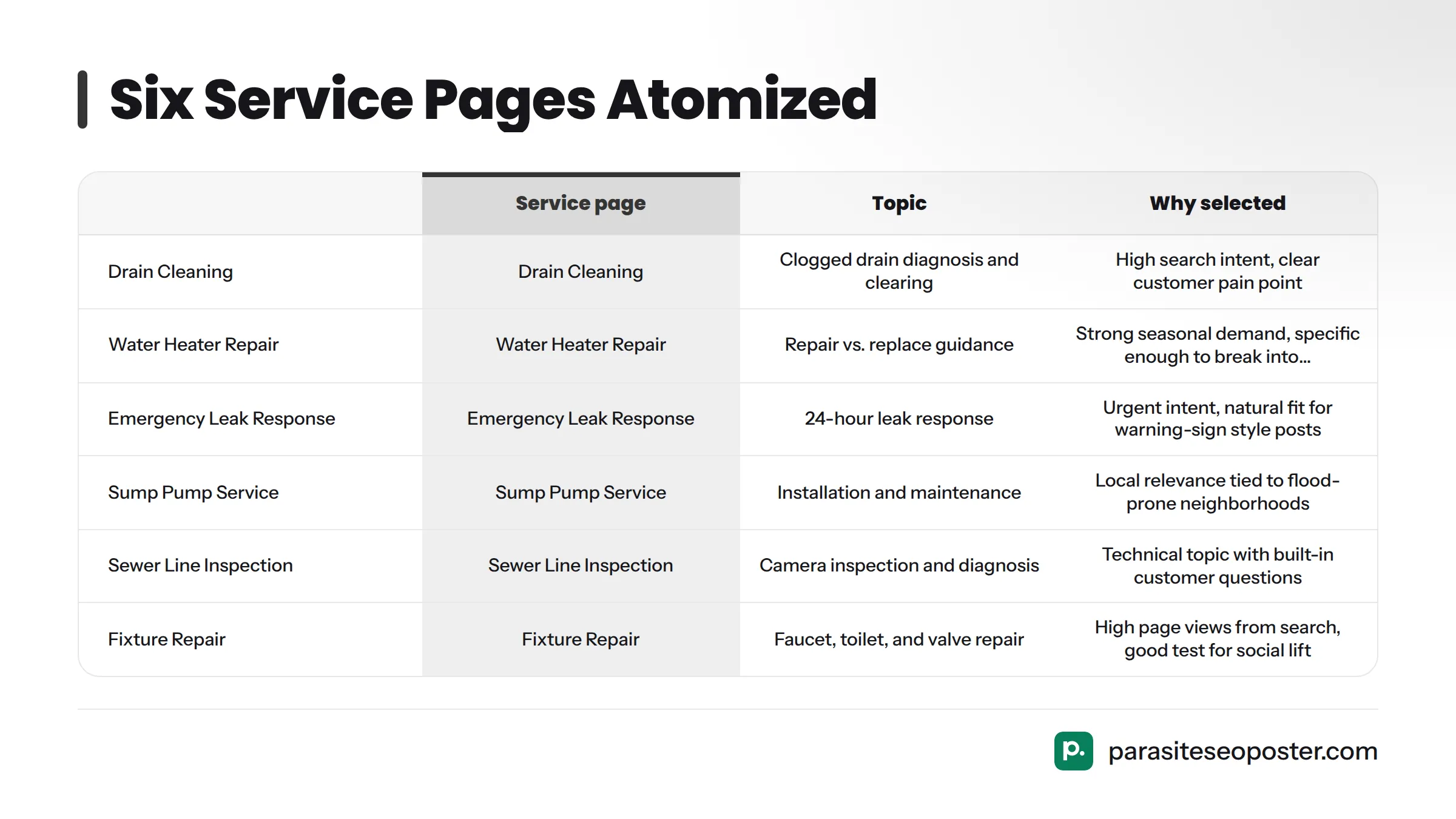
The Six Pages That Were Atomized
| Service page | Topic | Why selected |
|---|---|---|
| Drain Cleaning | Clogged drain diagnosis and clearing | High search intent, clear customer pain point |
| Water Heater Repair | Repair vs. replace guidance | Strong seasonal demand, specific enough to break into sub-topics |
| Emergency Leak Response | 24-hour leak response | Urgent intent, natural fit for warning-sign style posts |
| Sump Pump Service | Installation and maintenance | Local relevance tied to flood-prone neighborhoods |
| Sewer Line Inspection | Camera inspection and diagnosis | Technical topic with built-in customer questions |
| Fixture Repair | Faucet, toilet, and valve repair | High page views from search, good test for social lift |
Three Post Formats: How Content Was Atomized
Each source page produced multiple posts across three distinct formats. These aren't interchangeable - each format serves a different purpose.
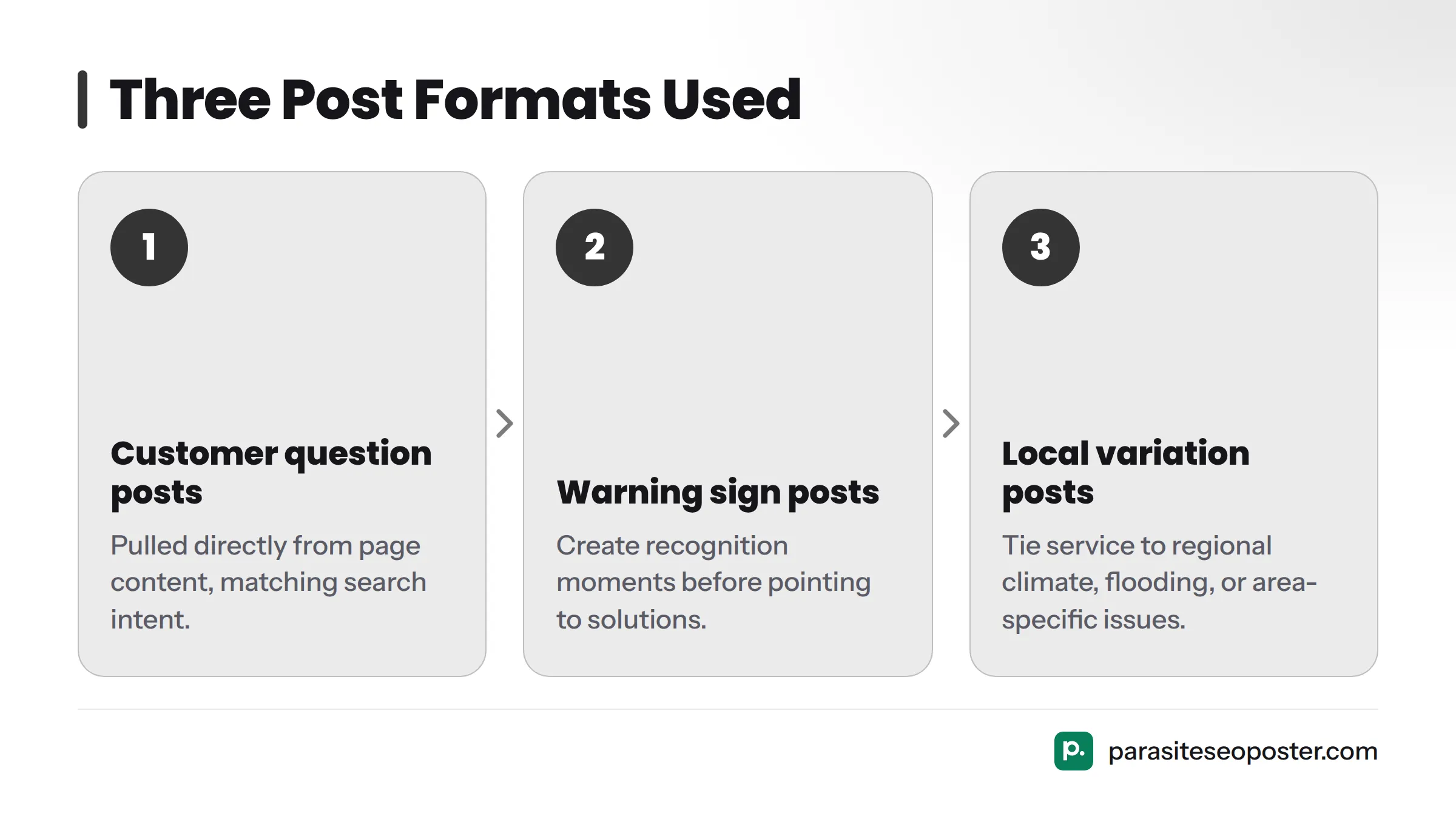
Customer question posts answer a question a real customer would type into search or ask a neighbor, pulled directly from the page's content.
Warning sign posts flag a symptom or red flag a homeowner might be missing, framed to create a moment of recognition before pointing to the solution.
Local variation posts localize the service to a specific neighborhood, climate condition, or regional issue relevant to Northline's service area.
Examples of each format
From the Sewer Line Inspection page, a customer question post read: "Why does my sewer line camera inspection take longer than expected? Older clay pipe and tree root intrusion both slow things down. Here's what our techs look for."
From the Emergency Leak Response page, a warning sign post read: "Warning sign: a water bill that jumped for no reason you can explain. That's often a hidden leak, not a billing error. Here's how we track it down fast."
From the Sump Pump Service page, a local variation post read: "If your street floods every time it rains hard, your sump pump isn't optional equipment, it's your basement's last line of defense. Here's what we check on every install in flood-prone blocks."
How the Posts Linked Back to Source Pages
Every post carried a link back to the exact page it came from, never to the homepage or a generic contact page. That link was the entire mechanism being tested: could a short social post send someone back to the original service page, and could that click be tracked?
Posts were scheduled and published across Northline's active social accounts using ParasiteSEOPoster's scheduler. Each post carried a tracked link pointing to its specific source page. A customer question post from the Sewer Line Inspection page linked only to that page. The one-to-one mapping made it possible to isolate which source page and which post type drove each click.
What the Data Actually Showed
The campaign ran for four weeks starting when the first posts went live. Tracked traffic means clicks on the links embedded in each post, attributed back to the specific source page that post came from.
Across the six atomized pages, click-back traffic appeared on five of the six pages within the measurement window. The Sewer Line Inspection and Emergency Leak Response pages - both represented by warning-sign and customer-question posts - accounted for the largest share of tracked clicks. The Fixture Repair page, despite already getting decent traffic from search, saw the smallest lift from its posts, suggesting the topic carries less urgency for a social audience than it does for someone actively searching.
One important caveat: these results depend heavily on the strength of the source page and its underlying keyword. ParasiteSEOPoster's platform intentionally withholds publishing for pages unlikely to realistically compete. This campaign's numbers reflect pages that passed that competitiveness check. A weaker page should expect a weaker outcome, and that's by design.
What Actually Worked Best
Warning-sign posts outperformed the other two formats for click-back volume. The likely reason: a warning sign creates a small moment of recognition - "wait, that's happening to me" - that a straight customer question doesn't quite deliver on its own. Customer-question posts came in second, probably because they match the search-style intent people already use, even when they're scrolling social feeds.
Local variation posts drove fewer clicks overall but kept the audience tightly aligned with Northline's actual service area, which matters more for a local contractor than raw click volume.
The Fixture Repair page's flat result suggests some service topics need a different approach than "here's a symptom" or "here's a question." A before-and-after framing or seasonal angle might work better - something the next campaign will test directly.
Three Takeaways for Other Local Service Businesses
If your service pages already answer specific customer questions, those pages are strong atomization candidates.
Pages tied to urgent, symptom-driven jobs (leaks, backups, no heat) tend to produce stronger warning-sign posts than routine maintenance pages.
Always check a page for competitiveness first. Know where it stands before building posts from it. A page that hasn't been vetted is a risky candidate.
This pattern applies to social media for contractors broadly and to social media marketing for plumbers specifically. It's part of a wider approach to turning social media posts from service pages that any local service business with an existing website can apply to its own page list.
Here's additional context from a different plumbing business's online marketing approach:
Start With Your Own Pages
Northline Plumbing didn't need a marketing department to run this. One person picked the pages, ran them through a competitiveness check, and let the platform generate and schedule the posts. If you're a contractor or local service owner with pages already on your site waiting for search traffic, you can start on the free plan and atomize your first page today. For more first-party results like this one, check the collection of social media case studies from other local businesses running the same approach.
Frequently Asked Questions
What did Northline Plumbing do with ParasiteSEOPoster?
Northline took six existing service pages from its website and ran them through ParasiteSEOPoster's content atomization engine, which generated customer-question, warning-sign, and local-variation social posts from each page. Each post carried a tracked link back to its specific source page, and clicks were measured over a four-week window.
Can other plumbers or contractors get the same results?
Results depend on the strength and competitiveness of the specific page being atomized. A page that doesn't pass a basic competitiveness check won't produce the same click-back volume. ParasiteSEOPoster is built to withhold publishing for pages unlikely to realistically compete, so outcomes vary business to business and page to page.
How long did it take to see results?
Northline's tracked traffic was measured over a four-week window starting from the first posts going live. Measurable click-back traffic appeared on five of the six atomized pages within that window.
Did Northline need a marketing team?
No. One person selected the service pages and ran the competitiveness check before letting the platform generate and schedule the posts. No dedicated marketing staff or agency was involved.